LIVE ZOOM WORKSHOP · TUESDAY, OCTOBER 27 · 5:30PM PT
Supporting Without Overaccommodating
How to Find the Balance in a World of Conflicting Messages
Live Workshop + Practical Toolkit + Bonus Q&A + Recording
Registration: $37
Accommodate your child. But not too much.
Challenge them. But don't push too hard.
Respect their limits, but don't reinforce avoidance. Build independence, but make sure they have the support they need.
If you're raising a child with a disability, you've probably heard some version of all of this.
And somehow, you're expected to know exactly where the line is.
But what if there isn't one right answer?
What if the question isn't simply whether you're providing too much support or expecting too little, but whether the approach makes sense for your child, in this situation, right now?
Join me for a live workshop where we'll move beyond conflicting advice and explore how to make thoughtful decisions about accommodations, independence, and skill development.
How do you know when to support and when to challenge?
Maybe your child can do something independently, but doing it takes so much effort that there's little energy left for anything else.
Maybe you've been told that accommodating anxiety will make it worse, but pushing through seems to make things harder.
Or maybe you're questioning whether a particular skill is something your child genuinely needs to develop—or simply something they've been expected to do.
These aren't always easy decisions.
And advice that makes sense in one situation may be completely inappropriate in another.
Neither accommodation nor challenge is inherently the wrong choice.
The challenge is learning how to evaluate what makes sense for your child, rather than following another set of rules that may not fit.
That's what this workshop is about.
What you'll learn
In this workshop, we'll explore how to:
1. Decide when to provide support and when to encourage a new skill.
Consider what your child needs, what you're trying to accomplish, and whether the expectation is appropriate in the first place.
2. Rethink what independence actually means.
Explore the difference between independence and autonomy, and why needing less support isn't always the best measure of progress.
3. Decide which skills deserve your attention.
Not everything needs to become a teaching opportunity. Learn how to prioritize what matters without feeling obligated to work on everything at once.
4. Make sense of conflicting advice.
Examine common recommendations about accommodations, anxiety, independence, and skill development—and learn what questions to ask before deciding whether they apply.
5. Recognize when it's time to change course.
Learn how to evaluate whether an approach is helping, when it may need adjusting, and why changing your mind isn't necessarily a sign that your original decision was wrong.
You'll leave with a framework you can use to think through real decisions, not another list of things you're supposed to do.
What's included with your registration?
The Live Workshop
We'll challenge some common assumptions about support, accommodations, and independence, examine real-life examples, and work through a practical decision-making framework.
The goal isn't to tell you exactly what to do in every situation. It's to help you ask better questions and make decisions that reflect your child's needs and your family's priorities.
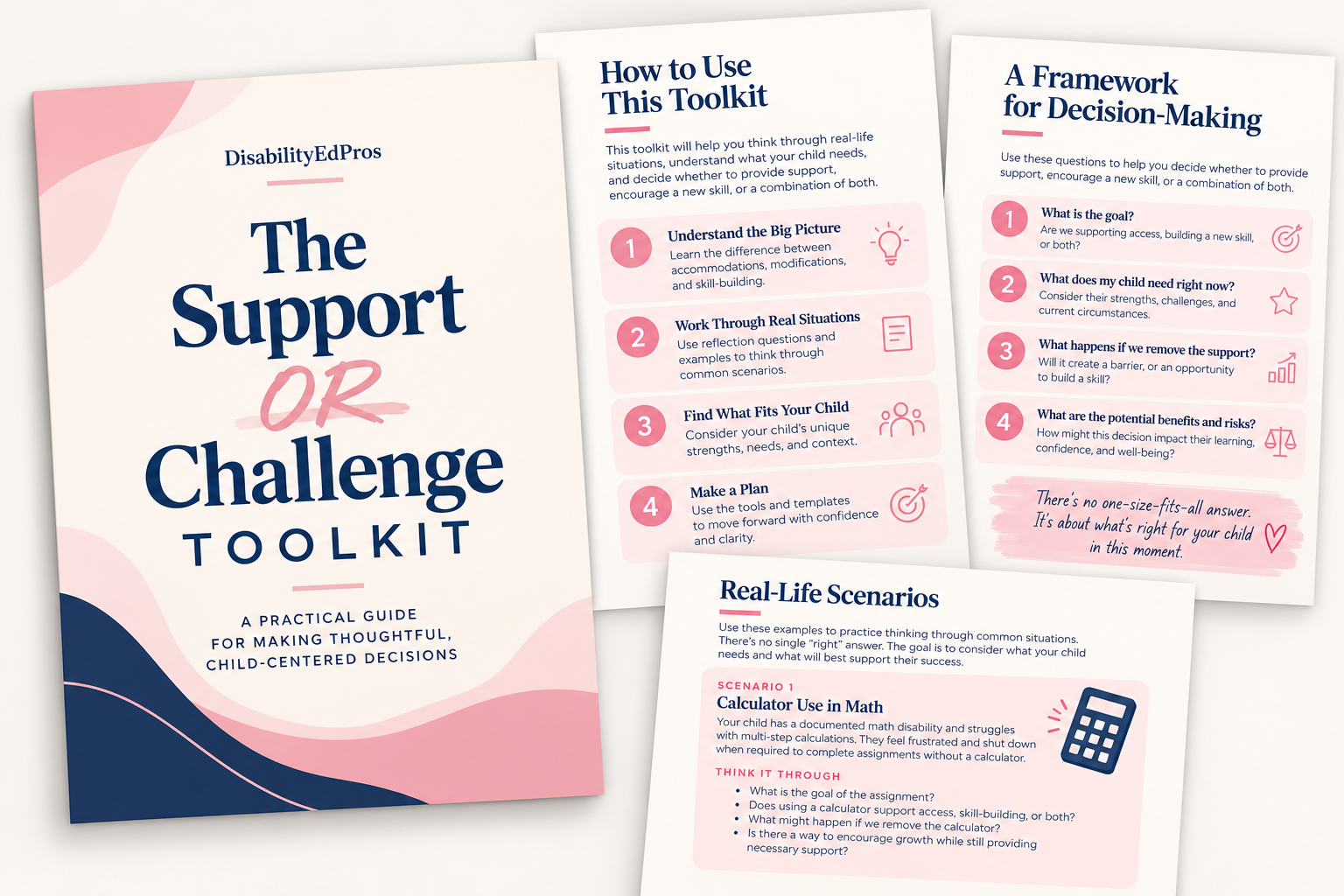
The Support OR Challenge Toolkit
A practical companion guide you can return to long after the workshop ends.
This isn't just a collection of blank worksheets.
You'll receive a substantive resource that includes:
- Understanding Support and Challenge: What accommodations, independence, autonomy, and skill development actually mean—and how they relate to one another.
- Making Sense of Conflicting Advice: Common recommendations, what they get right, what they overlook, and when they may or may not make sense.
- The Five-Question Decision Framework: A practical process for thinking through difficult decisions.
- Real-Life Examples: Situations involving home routines, school accommodations, anxiety, and developing new skills.
- Knowing When to Reconsider: How to recognize when an approach is working and when it may be time to adjust.
- Your Personal Decision Guide: A reusable tool for applying the framework to your own circumstances.
Because the decisions don't stop when the workshop ends.
BONUS: Live Q&A with Dr. Diana Fannon
Have questions about how these ideas apply to your child?
Submit your questions in advance or ask them live on Zoom!
We'll use the Q&A to explore real-life situations, competing priorities, and the considerations that can help inform your decisions.
Workshop Recording Included
Can't make it live? Want to revisit something afterward?
You'll receive access to the recording so you can review the material on your own schedule.
Who is this workshop for?
This workshop is for parents and caregivers of disabled and neurodivergent children who:
- Feel caught between advice to accommodate and advice to encourage independence.
- Wonder whether they're providing too much help—or expecting too much.
- Want to support skill development without unnecessarily sacrificing access, regulation, or participation.
- Are tired of advice that presents complex parenting decisions as simple rules.
- Want a more thoughtful way to evaluate what their child needs.
You don't need to have all the answers before you attend.
And you don't need to agree with every perspective we'll explore.
The goal is to examine the assumptions behind the advice and develop a way to make decisions that works for your child and family.

Meet your presenter
I'm Dr. Diana Fannon, founder of Disability Ed Pros.
I've spent more than 20 years in public education, including serving as a special education director, school psychologist, and teacher.
Throughout my career, I've worked with families and educators navigating complex decisions about accommodations, inclusion, access, and skill development.
I'm also the parent of a disabled child.
And that experience has led me to question some of the assumptions I once accepted about independence, support, and what progress is supposed to look like.
I bring both perspectives to this workshop because I understand the difference between recommending an approach professionally and making these decisions as a parent.
You don't need another set of rigid rules.
Sometimes progress means needing less support.
Sometimes it means learning to use support effectively.
Sometimes it means deciding that a particular skill isn't the priority right now.
And sometimes it means recognizing that something you tried isn't working and choosing a different approach.
The goal isn't to get every decision right. It's to understand what you're considering, why you're making a particular choice, and when it might be time to reconsider.
Join me for Supporting Without Overaccommodating
Live on Zoom · Tuesday, October 27 at 5:30pm PT
Your $37 registration includes:
- The live, interactive workshop
- The Support OR Challenge Toolkit
- Bonus live Q&A
- Access to the workshop recording
All for $37.